The short version
The Mardi Gras everyone means is on Galveston Island, about an hour south of central Houston when the road is clear. Seven to eight hours covers the round trip plus a parade for most groups. Size the bus to the people who have actually paid, settle one island drop-off and one pickup spot, and expect an all-inclusive quote that already accounts for the longer drive.
The causeway is the slowest stretch of the whole trip, and it comes at the very end, when the beads are in sight and the road has narrowed to one crawling lane of everyone else's plan. "We'll just take two cars" sounds fine at the kitchen table in Katy. On the island, it's a krewe of twenty-five split across a parking hunt in a town with nowhere to park.
Houston does Mardi Gras-themed bar nights, sure, but the real thing is fifty-odd miles down the Gulf Freeway. Mardi Gras Galveston fills the two weekends before Fat Tuesday with parades, balcony parties, and a ticketed entertainment district downtown — with a causeway at the end of the drive and almost nowhere to leave a car once you're over it.
What the drive down actually looks like
The route is simple enough: I-45 south past the Pasadena exits, through Clear Lake and League City, over the causeway, onto Broadway. Clear road, about an hour.
A parade Saturday is not a clear road. Things start thickening around Texas City, the causeway stacks up, and Broadway crawls the rest of the way into downtown. South-side groups get a shorter day out of it; anyone starting in Katy, Cypress, or north of the Beltway is adding a cross-town leg before the Gulf Freeway even begins. We work departure times backward from being on the island a good ninety minutes before the parade you actually care about, because those last five miles can eat as much clock as the first thirty.
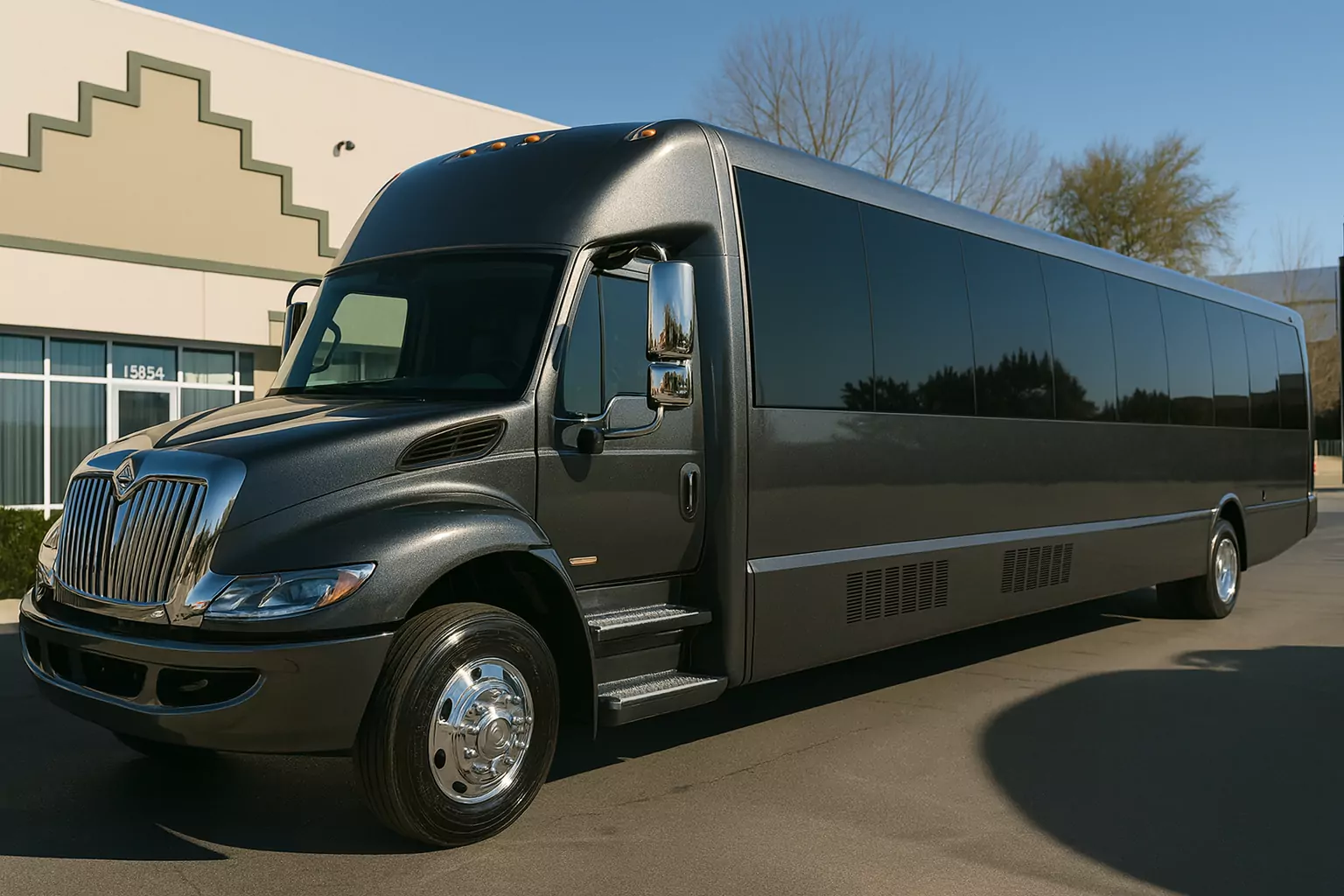 A 36-passenger bus, the size bigger Mardi Gras groups tend to ask about.
The ride is half the point anyway. Riders 21 and older can bring their own, the bar comes with ice and bottled water, and the sound system takes your phone. An hour of brass band playlists with nobody watching the speedometer beats three cars caravanning and losing each other at the Texas City wye.
Two parade zones, two very different drop-offs
Mardi Gras Galveston happens in two main areas, and they don't behave the same way for a bus.
Downtown and the Strand. On the main weekend nights the historic district around the Strand and Mechanic Street becomes a gated entertainment district — admission at the gates, streets closed to traffic, no vehicle of any kind going in. What works is a drop at the edge of the closure, a block or two outside a gate, and a short walk. Harborside Drive and the numbered cross streets shift year to year with the closure map, so rather than promising you a corner now, we confirm it the week of the event.
The Seawall. Several parades roll along Seawall Boulevard, which stays open and free to watch from the sidewalk. Drop-offs are much easier here, and groups who want beads without paying at a gate often prefer it. The catch is that Seawall traffic after a parade moves roughly at walking pace.
The organizers publish the schedule, routes, and gate details each year at Mardi Gras Galveston. Choose your parade, send us the date, and we'll build the day backward from its start time.
Galveston polls: what would you do?
Quick questions, real tallies. Vote to see how other riders answered — one vote per poll, no sign-up.
Where the hours go
This is where an island day parts company with a night out in town. Two hours or more of your block is highway before anything festive happens.
| Piece of the day | Realistic time |
|---|---|
| Pickups in Houston (one or two addresses) | 20–40 minutes |
| Drive to the island on a parade day | 75–100 minutes |
| Time on the island (parade plus food) | 3–4 hours |
| Drive home, late evening | 60–75 minutes |
| Drop-offs | 20–30 minutes |
Seven or eight hours, for most groups. In our Houston inquiry data, about 11% of inquiries with hours attached requested seven to eight hours, and Galveston days are a big part of why that band exists at all. There's no Mardi Gras-specific figure in there, so read it as a description of full-day trips generally. The much more common ask — about 34% of inquiries — is five to six hours, which only works for this trip if you're starting near the bay and skipping dinner.
The hours planner will total up your own version of that table.
Free planning tool
Hours Planner
List your stops across Houston and get a realistic number of hours to book.
Work out your hours →A four-hour minimum applies on Friday and Saturday nights, which no island trip is ever in danger of undershooting. One calendar quirk is worth knowing: Fat Tuesday wanders between early February and early March, and in a year when the big parade weekend falls in March, the six-hour Saturday minimum for March applies. You'd be booking well past that regardless.
Sizing a bus for a krewe
Mardi Gras groups run bigger than an ordinary Saturday night. Friends invite friends, and a parade is an easy thing to say yes to. About 13% of Houston inquiries with a group size were for 21 to 30 passengers, which is exactly the shape a parade trip takes. No Mardi Gras-only figure exists in our records, so treat that as context rather than a forecast.
Roughly how it maps:
- Up to 22 who've confirmed: the 22-passenger party bus keeps the per-person share reasonable and is far easier to place near the closures than something coach-length.
- 23 to 30: the 30-passenger party bus, which is the usual answer here. One vehicle, one meeting point, one head count.
- 31 to 40: the 36-passenger or 40-passenger party bus. There are very few buses this size anywhere, so ask early.
- Bigger still, and not fussed about dancing on the way: a 56-passenger charter coach moves a whole office or social club in forward-facing seats.
Capacity ratings are firm, and they bite harder on a highway run than on a city crawl. Count the people who've paid their share, not the ones who reacted to the message. If your number is still wobbling, the group size planner will help you land on a number.
The hard part happens on foot
Almost nothing goes wrong on the road. It goes wrong once everyone's off the bus — crowds are thick, phone service gets patchy when tens of thousands of people are posting video at once, and somebody always drifts toward a balcony.
Four habits that hold a group together:
- Settle the pickup spot before the first person steps off. Have the driver describe it out loud, then drop a pin in the chat while you still have signal.
- Set a hard pickup time and a rolling time. "Doors at 10:30, wheels at 10:45." A bus can't idle indefinitely on a street police are trying to clear.
- Give two people the counting job — one at the door, one at the back. Count on the way down so you know the number going home.
- Share the driver's contact with two people, not twenty.
Overtime works when the bus is free to stay and is billed after a 15-minute grace period. On a festival night, though, a late group usually pays in parade time rather than money, because the closure perimeter is not somewhere a bus can comfortably sit and wait.
 Masks and beads travel beautifully. Glitter does not.
Beads, costumes, and the one hard line
Bring the beads, the masks, all the purple, green, and gold you own. Decorations are welcome as long as nothing goes on the interior with tape. The single firm rule is glitter and confetti, which aren't allowed in any form — and a Mardi Gras costume is far and away the most common way glitter makes it on board. If an outfit sheds, leave it home or keep it bagged until you're on the island.
Drinks come in cans or plastic, never glass. Food stays off the vehicle, which on this trip costs you nothing, since eating on the island is easy and the king cake keeps until you're home. The cooler calculator will size ice and drinks against two highway legs. And with anyone under 21 riding, alcohol is only allowed when that rider's parent or legal guardian is aboard — otherwise the ride is dry, and the driver takes care of that so nobody else has to.
What the island run does to the number
Quotes are all-inclusive: vehicle, driver, fuel, taxes, and the driver's gratuity in one total, with local mileage inside it. When a route to Galveston runs beyond about an hour's drive from our base, the extra drive time gets priced in as a long-distance trip — you still get one number up front rather than a base rate and a mileage surprise on the way home. Festival gate admission is your group's own purchase, separate from the ride.
For scale only: among Houston party bus inquiries with a recorded historical quote, about 15% fell between $1,500 and $1,999, the band that generally means bigger buses and longer days. Those are historical quotes, not current prices, and a full-day island trip on a festival weekend belongs toward the upper end of them. Before anyone declares a total too high, run it through the split cost calculator — twenty-eight people sharing one bus usually looks good next to seven cars hunting island parking.
Your date is held once the contract is signed and the 50% deposit is in, with the balance following 7 to 14 days before the trip.
Want a number for your date?
Send the date, headcount, pickup area, and hours. The quote you get back already includes the driver, fuel, tax, and gratuity.
If the island isn't the plan
Some groups want the theme without the highway. A Mardi Gras-flavored bar crawl through Midtown or Washington Avenue sits comfortably inside a standard four-hour Saturday block. A daytime Galveston beach trip later in spring uses the same road with a fraction of the traffic. And if your group already lives near the bay, our Galveston page covers island pickups.