The short version
It divides a quote you already have among your riders four ways - evenly, with guests of honor riding free, with couples paying as one, or with custom shares per person. The shares always add up to the quote exactly, with any stray cent assigned rather than lost. Then it writes the group-chat message saying who owes what, and when.
"So what does everyone actually owe?" should take thirty seconds to answer. In most groups it takes three days.
The arithmetic isn't the problem. Agreeing what fair means before anybody does the arithmetic is the problem, and then chasing eleven payments that are each a few cents off because people rounded differently. The calculator above handles both ends: you pick the rule, it produces exact shares, and it drafts the message.
This page is about the fairness decision and the collecting. If what you want to know is what the quote means per person per hour, or what happens when people drop out, that's the cost planner.
Decide the rule before the number goes in the chat
Once a figure lands in a group chat, it becomes the figure. If the maid of honor posts "$104 each" and somebody then points out that the bride shouldn't be paying, you're renegotiating in public with an audience. Settle the rule with one or two people, run it, and post once.
There are four rules, and each suits a different kind of group.
| Split rule | Suits | Watch out for |
|---|---|---|
| Even split | Friend groups where nobody is being honored | Nothing, it is the simplest |
| Guests of honor ride free | Birthdays, bachelorette and bachelor parties, retirements | Everyone else's share rises slightly |
| Couples pay as one | Mixed groups of couples and singles, double-date nights | Which version of "as one" you mean |
| Custom shares | Late joiners, a host paying extra, a sponsor | Needs a sentence of explanation in the chat |
Rule one - the guest of honor rides free
This fits the most common reason anybody contacts us in the first place. About 32% of inquiries with a recorded event type in our Houston inquiry data were birthdays, miles ahead of every other occasion.
You give it the quote total, the number of riders, and how many people ride free — two, if it's a joint birthday or a couple's engagement party. Those riders get a share of zero and the total spreads across everyone else.
Fourteen on a bachelorette night
Say your quote is $1,450 for a Saturday night on a 22-passenger party bus, hypothetically, with fourteen riders and the bride riding free. That total sits in the $1,000 to $1,499 band where about 47% of recorded historical quotes in our data fell. Past quotes, not current prices.
So thirteen people share $1,450, which doesn't divide into clean cents. Some riders get $111.54 and some get $111.53, and you're told which. The shares add to $1,450.00 exactly.
That step sounds fussy until you skip it. Thirteen people all rounding up to $111.54 hands you $1,450.02. All rounding down leaves the organizer eleven cents short. Tiny sums, and precisely the kind of mismatch that makes a payment spreadsheet stop balancing at 11 PM on a Thursday. The bachelorette party page covers the rest of that night.
Rule two - couples pay as one
"Couples pay as one" means two completely different things to two different people, which is why you get asked which one you mean.
- Two seats, one payment. A couple covers both seats in a single transfer. Everyone still pays the same per seat. This is about collecting fewer payments, not about changing anyone's share.
- One share for two people. A couple pays what a single rider pays. This does change the shares, and it moves money onto the singles.
Six couples and eight singles
Say your quote is $1,200, hypothetically, for twenty riders going from Sugar Land to dinner and a couple of bars. Six couples, eight singles.
| Rule | Units the total is divided by | A couple pays | A single pays | Payments to collect |
|---|---|---|---|---|
| Two seats, one payment | 20 seats | $120.00 | $60.00 | 14 |
| One share for two people | 14 shares | about $85.71 | about $85.71 | 14 |
Under the second rule each single rider pays roughly $25.71 more than their own seat costs, so that every couple pays about $34.29 less. Some groups think that's entirely fair, particularly when the couples are hosting. Others would be quietly annoyed and never say so. Run both, look hard at the single rider's number, and choose knowing what you chose.
 Settling the rule first keeps the money talk out of the night itself.
Rule three - custom shares for everything else
Custom shares cover every arrangement the other three can't. Each rider gets a name and a weight: 1 is a normal share, 0.5 is half, 2 is double, 0 means they ride free.
Late joiners on a birthday
Say your quote is $1,260, hypothetically, for sixteen riders on a birthday party. Twelve are there for the whole night. Four are meeting the bus at the second stop in Midtown after work and only riding the back half.
Give the twelve a weight of 1 and the four a 0.5. That's fourteen units, so a full share is $90.00 and a half is $45.00. Twelve times $90 plus four times $45 is exactly $1,260.
Other ways people use weights:
- The host covers extra. A weight of 2 doubles their share, which is a gracious way to lower everyone else's cost without the host paying for the entire thing.
- A parent or sponsor contributes. On a family trip or a graduation outing, the adult paying gets a larger weight and the teenagers get 0.
- Someone's only riding one way. A 0.5 is simple, defensible, and ends the discussion.
Keep the weights few and easy to explain, though. A split with seven different weights in it needs seven separate conversations to defend.
Booking experience polls: what would you do?
Quick questions, real tallies. Vote to see how other riders answered — one vote per poll, no sign-up.
What the group-chat message says
Once the shares are set, you get a short message to copy in one tap. It carries the total and rider count, each group of payers with their amount, a line confirming the shares add up exactly, and a reminder that the 50% deposit holds the vehicle and the balance falls due 7 to 14 days before the event.
Paste it, then add two things of your own: how you want to be paid, and the date you need the money by. Pick a collection date a few days before you intend to sign, not the day of the deposit. People who've already paid rarely drop out. People who haven't paid are exactly the ones who cancel the week before.
Collecting without spending two weeks chasing it
Whoever signs the contract has to be 21 or older, and that person owes the full total no matter what's happening in the chat. Which is why the order you do things in matters.
- Before signing, collect at least half of every share. That covers the 50% deposit without anyone fronting it out of their own account.
- Sign and pay the deposit. It's non-refundable, and saying so in the chat stops people treating their share as a maybe.
- Collect the rest comfortably before the balance is due 7 to 14 days out.
- If someone drops out, the total doesn't move. Either the group absorbs it or that person's share isn't refunded — and it's far easier to agree which before step one than after step three.
Booking inside seven days of the event? Payment in full is due up front, so everything gets collected before you sign. The whole sequence is laid out in our guide to how booking and deposits work.
Why you divide the full quote and nothing else
Every quote we write is all-inclusive — the vehicle, the driver, fuel, local mileage, taxes and driver gratuity all live inside that one number. So divide the full quote and stop there. No tip line, because it's already paid. Nothing held back, because there's nothing hidden waiting to be topped up later.
If the group has other shared costs, a dinner deposit or the like, split those separately so the transport share stays clean and arguable on its own. For school events, the prom budget planner is built for families and sets the ride beside tickets, attire and dinner.
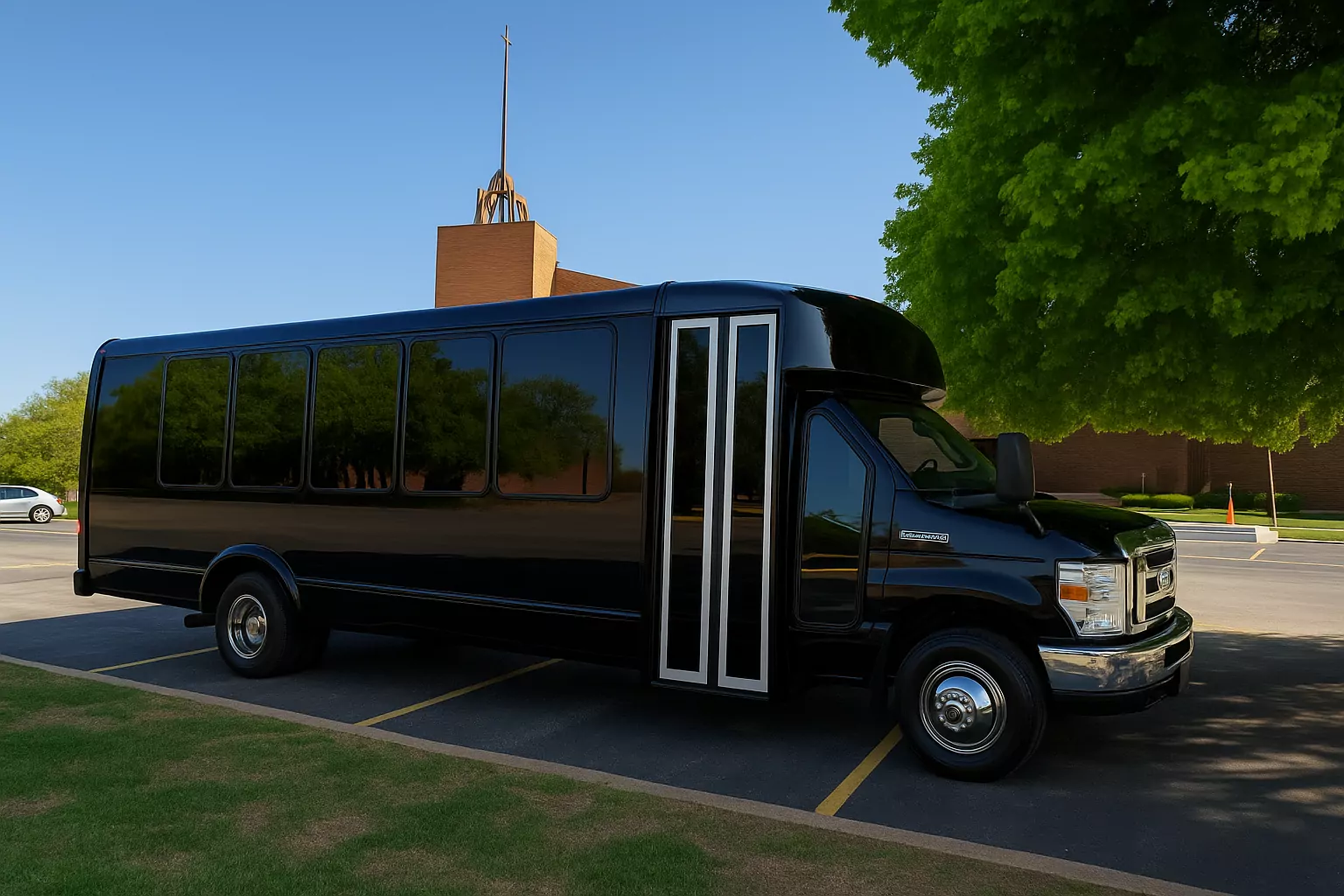 A 22-passenger bus, the size a lot of groups of fourteen to twenty end up splitting.
Put real dates on it
A split is only as good as the dates attached to it. The booking timeline takes your event date and works out when to collect, when to sign, and when the balance falls due — so the message you just copied has actual deadlines in it rather than "soon".
Free planning tool
Booking Timeline
Pick your event date and type; get a dated checklist of what to lock in and when.
Build your timeline →With the total and the dates in hand, send us the details through the quote form or call or text (281) 549-2511 between 8 AM and 8 PM.
Want a number for your date?
Send the date, headcount, pickup area, and hours. The quote you get back already includes the driver, fuel, tax, and gratuity.