The short version
Give it the quote total you were handed, your rider count, and your hours, and it returns cost per person, cost per person per hour, and what each share becomes if people drop out. It never estimates a price. The point it makes is simple - a whole-trip total only means something once you divide it by riders who have truly said yes.
Is $1,350 a lot? Impossible to say until you know who's splitting it. Quotes arrive as one number for the whole trip, and one number is hard to have a feeling about — thirteen hundred-something sounds heavy right up until it's spread across seventeen people and five hours.
So the planner above does the dividing. It won't guess what a trip costs, because we don't publish rates and a calculator that invented one would be lying to you politely. It works on the number you were quoted.
The question it answers
It answers "what does this quote mean for each person riding?" — which is a different question from "what will my trip cost?" Only a real quote for your date, hours and vehicle can answer that one. No quote yet? Request one here or text (281) 549-2511, then come back with the total.
This is for whoever is holding the quote: the birthday organizer, the best man, the parent with the group chat permanently open. It gives you three things you can take back to that chat.
- Cost per person for the whole trip at the headcount you have now.
- Cost per person per hour, which is the only fair way to weigh a party bus against anything else the group might spend a night on.
- Cost per person if riders drop out, so the worst case is something you've already seen rather than something that ambushes you.
It also spells out what the quote already covers, which tends to matter more than people expect.
What to type in, and what not to fudge
Your quote total goes in first, and it should be the all-in figure from a written quote rather than a number someone half-remembers from a phone call. Then riders — people who have said yes, not people who left a thumbs up on a message in February. Then hours, meaning the block you were quoted for, and it's worth knowing that Friday and Saturday nights start at four, Sunday through Thursday can start at three, and every Saturday in March, April and May starts at six.
The last input is possible drop-outs, and that's the one people fudge. On a group of sixteen, two is a perfectly normal number, and pretending otherwise doesn't make it less likely.
Move one input at a time and watch which figure jumps. Riders shift the per-person number hard. Hours shift the per-hour one — though in our experience, groups regret booking too short far more often than too long.
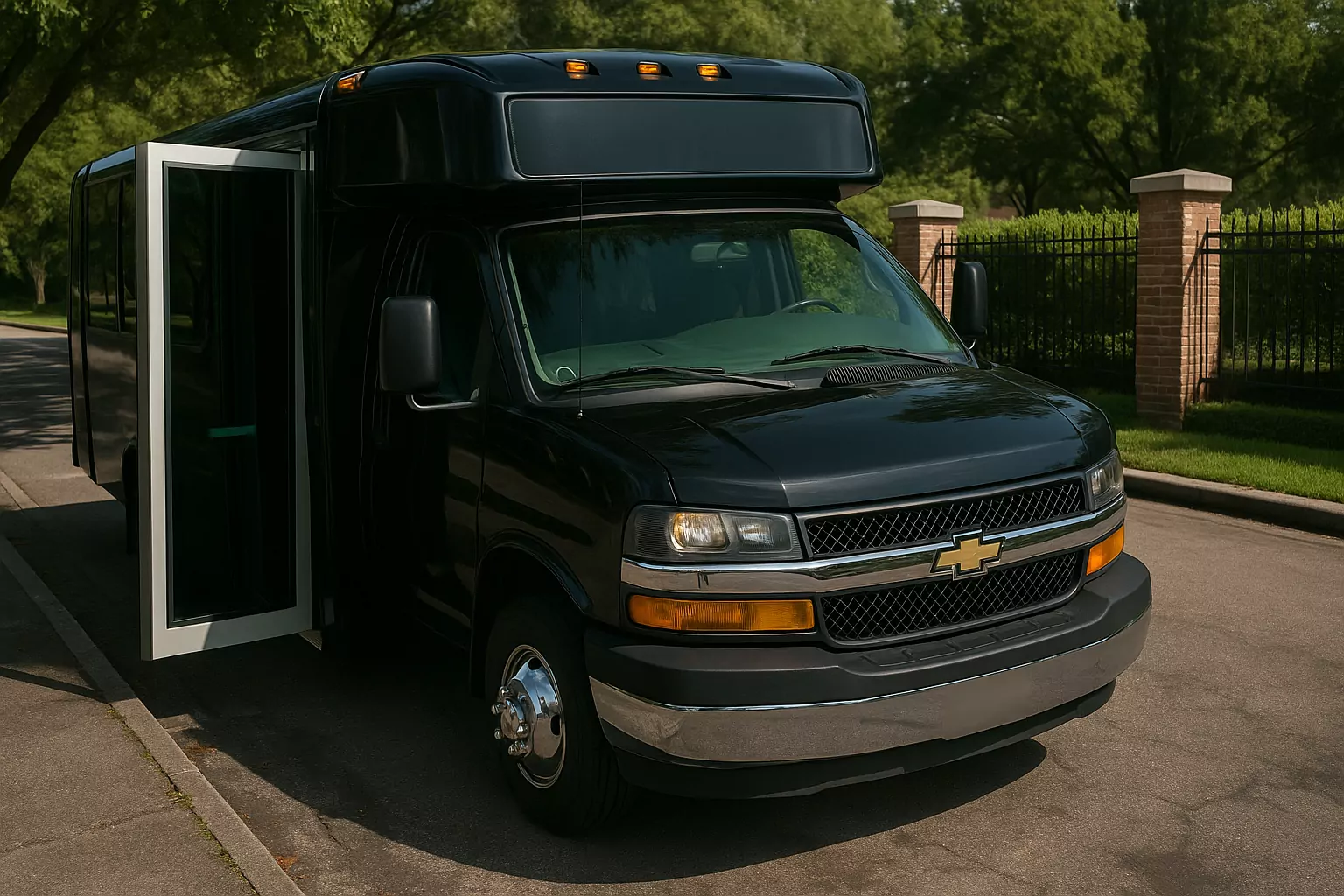 A 20-passenger bus, the size a lot of mid-sized Houston groups end up dividing a quote across.
What's already inside that total
Every quote we write is all-inclusive. The figure you're typing in already holds the vehicle for the whole block, a licensed and commercially insured driver, fuel, mileage inside Greater Houston, taxes and fees, the driver's gratuity, unlimited stops within your hours, and ice and bottled water in the bar on party buses and limousines.
That's why there's no box for a tip or a fuel surcharge. On a normal local trip there's nothing to add on top and nothing waiting at the end of the night. If you're weighing our quote against someone else's, the thing to check is whether theirs covers the same list, because a lower total with gratuity and fees left off isn't lower at all. Our quote checklist names the lines to look for.
Four things do sit outside a standard quote, and no calculator can see them coming: overtime past your booked hours, billed after a 15-minute grace period; a route reaching more than about an hour's drive from our base; a second driver on days running past roughly 12 hours; and cleaning fees if the vehicle comes back in a state.
Sixteen friends, the Heights to Midtown
Made-up trip, made-up inputs — this is here to show the arithmetic, nothing else.
Say your quote is $1,350, hypothetically, for a five-hour Saturday night on a 22-passenger party bus. That total sits inside the $1,000 to $1,499 band, where about 44% of the historical party bus quotes in our Houston inquiry data landed. Past quotes, not current prices, and your own number will follow your date and vehicle.
You've got sixteen confirmed riders for a birthday starting in the Heights, stopping on Washington Avenue and ending in Midtown.
| Scenario | Riders | Per person | Per person per hour |
|---|---|---|---|
| Everyone shows | 16 | $84.38 | $16.88 |
| Two drop out | 14 | $96.43 | $19.29 |
| Four drop out | 12 | $112.50 | $22.50 |
The total never moved. All that changed is how many shoulders are under it. Two fewer riders added about twelve dollars each, which most groups absorb without comment. Four fewer added twenty-eight, and that's the size of jump that starts a row in the week of the party.
Which is the entire reason the drop-out box exists. Work out now what the group does at fourteen and at twelve, and put it in the chat before anybody pays anything.
A short Sunday run, where the math flips
Say your quote is $840, hypothetically, for three hours on a Sunday afternoon with twelve riders visiting a couple of taprooms east of downtown. About 36% of historical party bus quotes in our records came in under $1,000 — mostly shorter blocks, smaller vehicles and off-peak days exactly like this one. Again, that's what was quoted in the past, not what you'll be quoted.
Twelve riders makes it $70.00 each, or $23.33 per person per hour. Two cancellations take it to $84.00 each.
Here's the interesting part: the per-hour figure is higher than the Saturday example even though the total is much lower. Short blocks spread the fixed parts of any trip across fewer hours. That's not an argument for booking time you don't need, but it is a good argument against judging a quote by its total alone. Planning something similar? The brewery tour page covers routes and timing.
So what do you do with the number?
If the per-person figure feels high
Look at the headcount before anything else. Two more confirmed riders is by far the cheapest way to bring it down, assuming the vehicle has the seats — capacity ratings are firm, so check with the group size planner before you start inviting people the bus can't legally carry.
If it's the drop-out row that worries you
Then collect the money before the deposit is due rather than after. People who've paid turn up; people who haven't are the ones who text you on the Thursday. The split cost calculator turns your total into exact shares and writes the message for you.

Free planning tool
Split Cost Calculator
Divide a quote fairly: even split, host rides free, or couples pay as one.
Split the bill →If you're weighing the per-hour figure
Compare it against what the group was going to spend anyway. For a night with several legs across town, the rideshare vs. party bus comparison sets both against each other and will tell you plainly when rideshare wins, because sometimes it does.
Party buses polls: what would you do?
Quick questions, real tallies. Vote to see how other riders answered — one vote per poll, no sign-up.
Why it divides by the people who said yes
Two booking rules make this less pedantic than it sounds. A date is held by a signed contract and a 50% deposit, and that deposit is non-refundable. The balance then falls due 7 to 14 days before the event. Between those two moments, the person who signed owes the full total regardless of how many friends are still answering messages.
So the only number that counts is the one you can collect. Eighteen invited and thirteen committed? Run it at thirteen. If it works there, book it. If it only works at eighteen, what you have isn't a plan yet.
The same reasoning is why we suggest sizing a vehicle for confirmed riders plus a seat or two rather than the whole invite list. A bigger bus lifts the total while the drop-outs lift each share, and those two effects arrive together.
 Perimeter seating on a 22-passenger bus. Every seat you fill lowers the share for everyone else.
The five ways this goes wrong
- Using an old quote. A quote is tied to a date, a vehicle and a block of hours. Change any one and the total changes with it, so re-run the numbers with the new figure rather than the comforting old one.
- Adding gratuity on top. It's already in there. Adding 20% inflates every result you see.
- Trimming hours to hit a target. A four-hour plan squeezed into three tends to end in overtime, which costs more than the hour would have. Test the route in the hours planner first.
- Counting the guest of honor as a payer. If the group is covering the birthday person or the bride, divide by one fewer and stop kidding yourself.
- Comparing totals across different days. A Sunday afternoon and a Saturday night aren't the same product. Compare per person per hour, and compare like with like.
What it can't tell you
It can't tell you what your trip will cost, whether a vehicle is free on your date, or whether your hours cover your route. It knows nothing about a longer run down to Galveston, or a day that needs a second driver. And it can't tell you whether a quote is fair — only what it comes to once divided.
For any of that, call or text (281) 549-2511 between 8 AM and 8 PM with the date, pickup area, headcount and rough plan, and you'll get a written all-in total you can bring back here. If you want the background on what pushes a total up or down, the Houston party bus cost guide goes through it.
Want a number for your date?
Send the date, headcount, pickup area, and hours. The quote you get back already includes the driver, fuel, tax, and gratuity.