The short version
Book five to six hours and the whole night fits - the ride in, the full set, and the trip home while everyone else is still inching out of a garage. Your driver drops the group near the entrance, stages off site, and meets you at a corner you chose on the way in. Riders 21 and up can bring cans or plastic, and the quote is all-inclusive.
The show is three hours. The part your group will complain about is the ninety minutes wrapped around it — forty-five spent creeping through a garage and a security line, then forty-five more sitting in a parking structure afterward watching rideshare prices climb.
A chartered vehicle does nothing at all for the music. It fixes that hour and a half, and it gives everybody one place to be before and after. Since every Houston venue treats a big vehicle differently, most of what follows is sorted by where you're going.
Nobody books a bus because of the bus
Concerts aren't our biggest category, and we'd rather say so than dress it up. Our Houston inquiry data puts concerts at about 4% of inquiries with a recorded event type. What those calls have in common is the reason behind them: it's almost never the vehicle. It's the parking and the exit.
So the advice splits two ways. If you just want to get home without a fight, size it to the people and keep the hours realistic. If the ride is meant to be the warm-up, a party bus with a sound system starts earning its keep long before you reach the doors.
 The show is the easy part. Everything around it is the plan.
Every Houston stage has its own quirks at the curb
Toyota Center
The arena takes up a block of southeast downtown between Polk, La Branch, Bell, and Jackson. Getting dropped on one of those streets before doors is simple enough. Afterward is a different animal — police are directing traffic and the nearest curbs belong to a wall of rideshares. Walk two or three blocks first, toward Discovery Green or south toward Leeland, and have the driver meet you there. Event-night details go up on the arena's own site.
NRG Stadium
Stadium tours land here, and so does every RodeoHouston headliner. Which gates and lots will take a bus is NRG Park's call, and it shifts from event to event, so we check the current rules before your date. Count on a longer walk than an arena gives you and a slower crawl out, because Kirby, Fannin, and the South Loop all fill at the same moment. Rodeo nights work differently enough that they live on our Houston rodeo transportation page.
Cynthia Woods Mitchell Pavilion
An outdoor amphitheater in The Woodlands, about 30 miles up I-45 from downtown, with covered reserved seats and a big open lawn. Coming from inside the Loop on a weeknight, give it an hour and fifteen. That distance is exactly why this venue makes the strongest case for a bus — nobody wants to drive back to Pearland from The Woodlands at midnight. The Pavilion's site spells out what the lawn allows.
713 Music Hall
Tucked into the POST Houston development on the north edge of downtown, in the old main post office on Franklin Street. It holds around 5,000, mostly standing. The streets around POST are unusually wide for downtown, which makes the drop-off painless, and the food hall in the same building takes care of dinner.
White Oak Music Hall
North Main in the Near Northside, with indoor rooms and an outdoor lawn stage. The blocks around it are residential and short on parking, and a full-size bus has no business idling there. Plan the drop on North Main itself and settle a pickup point with your driver before you walk in.
Smart Financial Centre
Out in Sugar Land just off US-59 at University Boulevard, a seated theater with its own surface lots. Access here is the easiest of anywhere on this list, which is why Fort Bend County groups tend to build the night around dinner at Sugar Land Town Square first.
Pick your corner before the lights go down
Phones get useless when several thousand people leave a building at once. Texts land late, map pins wander, and somebody is always "right by the sign." The groups that get out fast all do the same three things.
- They name an actual corner on the way in. "Polk and Crawford, northeast corner" survives the chaos. "Out front" does not.
- They pick a spot a few blocks out. Five minutes of walking almost always beats twenty minutes of a bus nosing toward the door through barricades.
- They put one person in charge of calling the driver. Everyone else just follows that person.
Anyone who's had enough before the encore can head back and wait on board. The driver stays with the vehicle the whole time.
Party buses polls: what would you do?
Quick questions, real tallies. Vote to see how other riders answered — one vote per poll, no sign-up.
So how long do you really need it?
Our minimums are four hours on Friday and Saturday nights, and three on a lot of Sunday-through-Thursday dates. Very few concert nights squeeze into either one, because the clock keeps running while you're inside the venue.
| Piece of the night | Arena downtown | Pavilion from inside the Loop |
|---|---|---|
| Pickups and the ride in | 45–60 min | 75–90 min |
| Doors to end of headliner | About 3 hours | About 3.5 hours with openers |
| Walk out and load | 20–30 min | 30 min |
| Ride home and drop-offs | 45–60 min | 75–90 min |
| Realistic block | 5 hours | 6 to 7 hours |
If five or six hours sounds like a lot, it isn't — about 34% of the inquiries we see with a requested duration ask for exactly that. Should the show run past your end time, overtime kicks in after a 15-minute grace period, assuming the vehicle is free to stay. On a packed Saturday it often isn't, so it's kinder to yourself to book the hours the night needs. Our guide to choosing party bus hours walks through the estimate with you.
Your ticket block decides the vehicle
Concert groups arrive in every shape, because presales do.
Ten or fewer, and you're looking at a 10-passenger limousine or the 12-passenger limo Sprinter. The Sprinter's standing-height door is a lot friendlier to anyone in boots and a jacket, and either one slots into a tight downtown curb more easily than a bus.
Among party bus inquiries in our records, about 57% were for 11 to 20 passengers. That's the classic concert crew, and the 22-passenger party bus handles it with space left for a cooler. When the ticket block gets bigger — an office group, or a birthday built around a show — the 26-passenger and 30-passenger party bus take over.
One caveat worth saying early: capacity is firm. If somebody's cousin turns up a ticket that afternoon, there has to be a rated seat waiting for them.
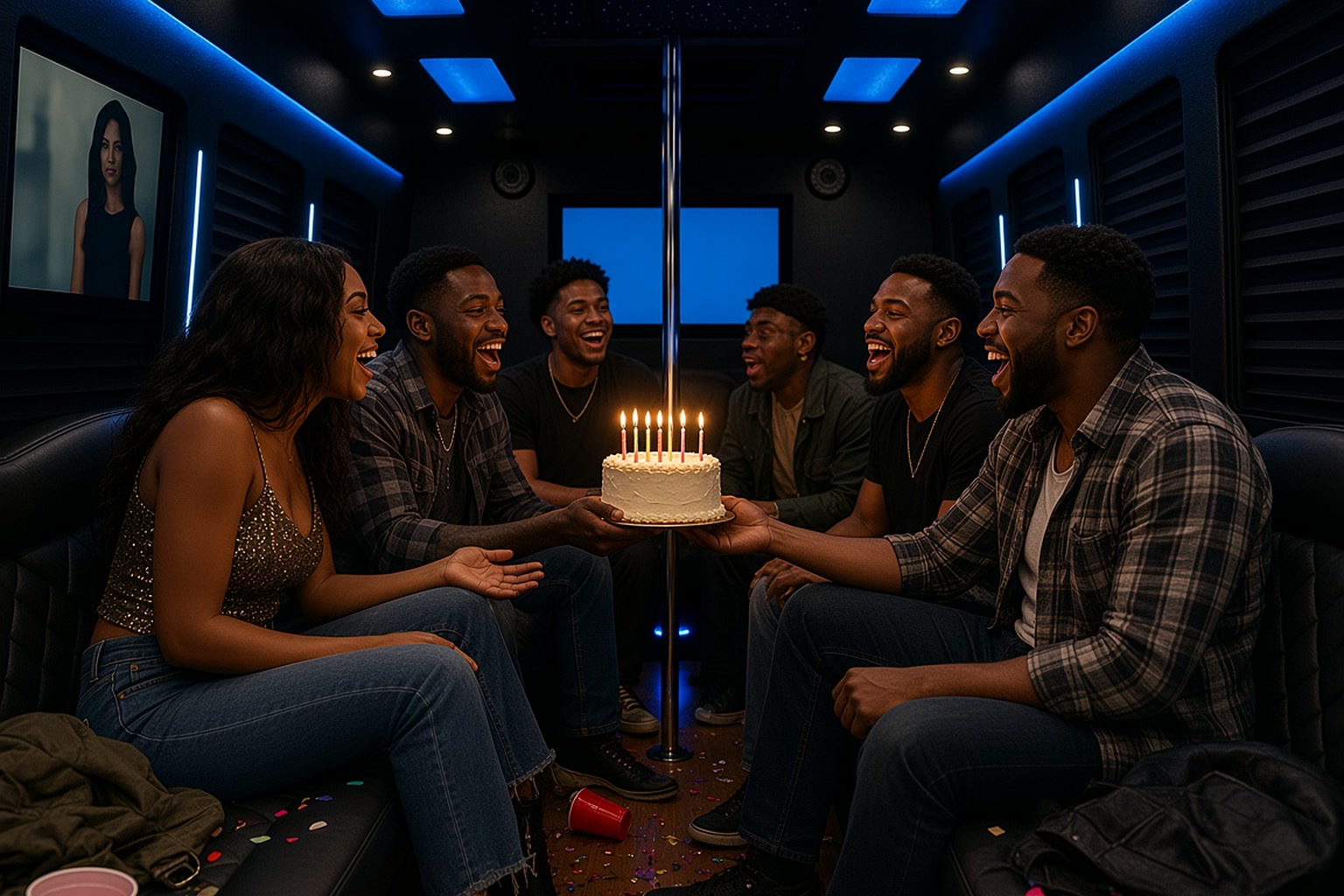
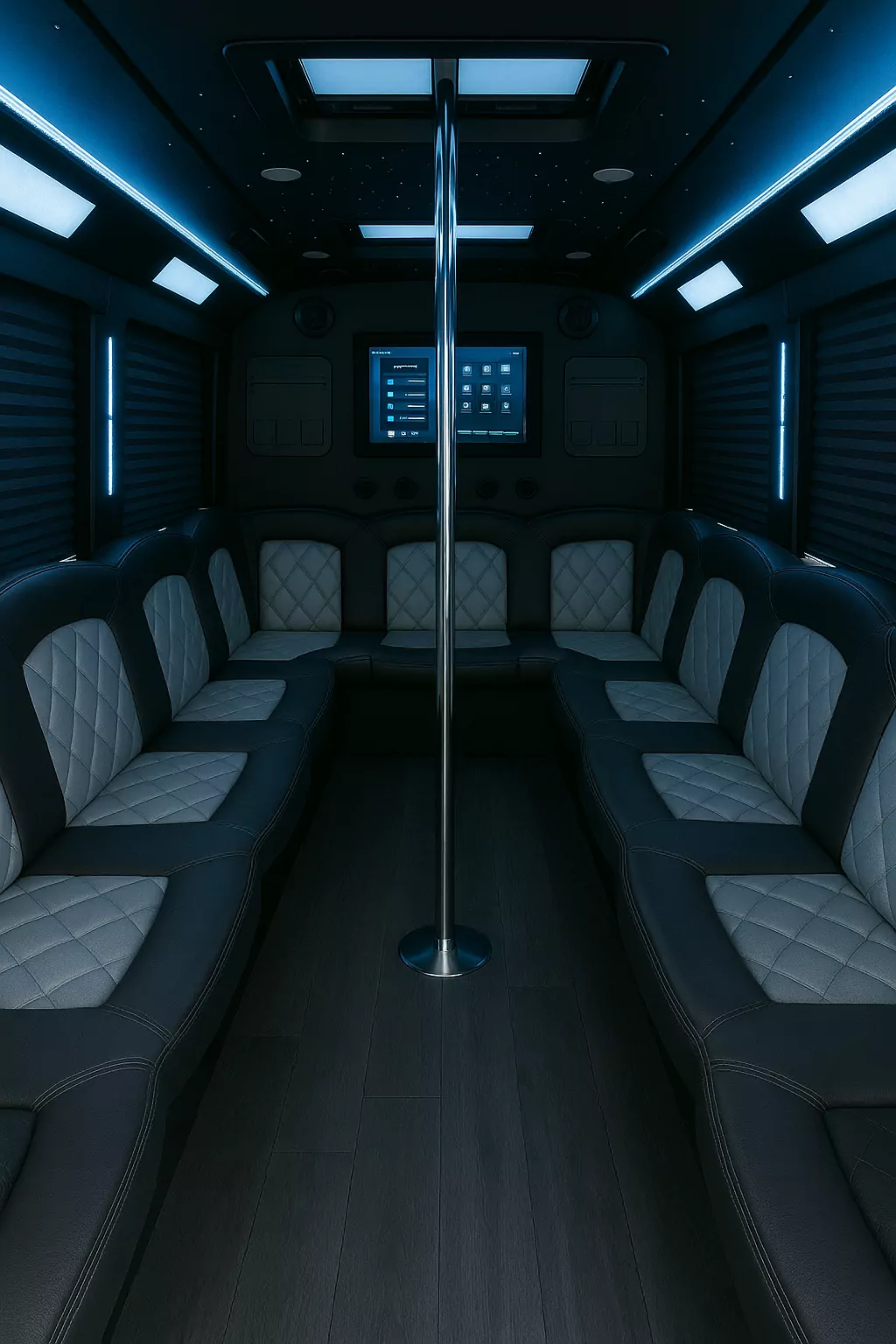 Perimeter seating on the 22-passenger bus, where the pre-show actually happens.
The part that starts before the opener
No garage on earth gives you this. The sound system pairs over Bluetooth, so the ride in becomes the back catalogue at whatever volume the group votes for.
Anyone 21 and older can bring their own drinks. Cans or plastic, since glass doesn't ride on a moving vehicle, and we don't sell alcohol ourselves. Ice and bottled water are already in the bar on party buses and limousines. Food stays off board, so eat beforehand or work a stop into the route. And if there's anyone under 21 in the group without a parent or guardian riding along, the whole trip is dry.
Here's the venue-specific wrinkle: whatever you open on the bus is staying on the bus. Finish it or leave it in the cooler for the trip home. The cooler calculator is good at telling you how much a group your size really gets through in the hours you have, which is usually well under what people pack.

Free planning tool
BYOB & Cooler Calculator
How many drinks, how much ice, and how many cups for your group and hours.
Pack the cooler →If you want the rest of the packing list, we keep one at what to bring on a Houston party bus.
Does it beat five rideshares?
Sometimes, and the full comparison has more lines in it than people expect. Driving yourselves means event parking for every car, fuel, and one person per car staying sober all night. Rideshare means a normal fare in, then a surge fare home that nobody can predict, times the four or five cars a group of eighteen would fill.
Set against that, a bus is a single fixed, all-inclusive number — vehicle, driver, fuel, local mileage, taxes, and gratuity. For historical reference only, about 44% of past party bus quotes in our Houston records fell between $1,000 and $1,499 for the entire trip. Those are past quotes, not today's prices. Put your own numbers in and see where your group lands.
Free planning tool
Rideshare vs. Party Bus
Compare the real cost and hassle of several rideshares against one vehicle for the whole group.
Run the comparison →Want a number for your date?
Send the date, headcount, pickup area, and hours. The quote you get back already includes the driver, fuel, tax, and gratuity.
Lawn seats, heat, and the storm nobody planned for
The Pavilion's lawn and White Oak's outdoor stage mean real heat from May through September, plus the kind of storm that arrives in twenty minutes. A waiting vehicle is air conditioning during a lightning delay and somewhere dry to stash ponchos and soaked lawn blankets afterward.
Festival days are their own beast. Book to the latest realistic finish rather than the posted set time, and agree on a check-in hour so anyone who's done can drift back to the bus without texting the whole group.
A lot of concert nights are really something else with a show in the middle. If yours is a celebration, the birthday party page has the group-size detail. If it keeps going after the last song, the nightclub tour page covers late stops, and games at those same arenas are on the sporting events page.