Party Bus In Houston
The short version
Build a manifest first - names, airport, flight times, bags, destinations - then group travelers into arrival windows and size each vehicle on people and luggage together, not seats alone. Arrivals get 30 minutes from landing to meet the driver, so buy extra wait for checked bags or customs. Weekday runs often book at three hours, and a repeat route is easier quoted as one arrangement.
There is no less glamorous trip than an airport run, and none where a missing detail costs you more. A senior director standing at Terminal C with a dead phone and no driver is a bad afternoon for everybody. The good news is that almost all of this is won in advance, on paper, weeks before anyone boards a plane. This is written for the person holding the list - the office manager, the travel lead, the executive assistant - who needs a plan that survives an early landing and a meeting that overruns.
Planning a holiday party or a client dinner instead? That's a different job, and our corporate event transportation guide is the one you want. This page is about moving people between airports, hotels and offices, once or over and over.
Four different things called "a shuttle"
"We need a shuttle" covers four jobs that get quoted and run quite differently.
| The job | What it looks like | How it is usually booked |
|---|---|---|
| Single transfer | A leadership team from IAH to a hotel, or a department from the office to a client site | One block of hours, often a three-hour weekday minimum |
| Arrival or departure wave | Twenty guests on six different flights over one afternoon | One vehicle per arrival window, or one longer block |
| Multi-day roadshow | Site visits, investor meetings, or a recruiting tour across several days | Quoted together as a package rather than separate days |
| Recurring shuttle | The same route on a set schedule, weekly or for a project | Discussed as a standing arrangement with frequency and headcounts |
Say which one you've got in the first line of your email and you skip an entire round of questions. If what you're really doing is cycling hundreds of attendees between hotels and a convention hall, that's a separate discipline - our conference shuttle page covers loop math and staging properly.
The spreadsheet is the whole job
The single most valuable thing you can send us is an unglamorous sheet. One row per traveler. These columns:
- Name and cell number, at least for the group lead on each vehicle
- Airport code, IAH or HOU, never just "Houston"
- Airline, flight number, and scheduled time
- Terminal, if the itinerary shows it
- Bags: carry-on only, one checked bag, two checked bags, or equipment cases
- Destination: the hotel or office, with the exact entrance
- Anything special: a rider who needs an easier entry, a service animal, a hard meeting start
Give us that and we can see the vehicle count, the sizes and the timings straight off it. Without it, every one of us is guessing. Anyone who uses a wheelchair or finds steps hard belongs in that last column, and our guide to accessible shuttles and Sprinters is worth reading early, because the pool of vehicles that fits that need is narrower.
Windows, not flights
Meeting every flight individually is the most expensive way there is to run an arrival day. Sort by airport, then bundle flights into windows of roughly an hour. Whoever lands first waits a while for whoever lands last, and one vehicle carries the lot.
Say it's a Tuesday offsite with sixteen people flying in:
| Window at IAH | Flights landing | Travelers | Vehicle |
|---|---|---|---|
| 10:30 AM to 11:30 AM | Three domestic flights | 7, mostly carry-on | One executive Sprinter |
| 1:00 PM to 2:15 PM | Four flights, one international | 9, several checked bags | One shuttle bus, extra wait booked for customs |
Two vehicles, two clean pickups, instead of seven separate runs across the day. Your 10:30 arrival draws the short straw, so tell them so in advance and point them at a coffee place near baggage claim. People wait happily when they were warned.
The Houston Airport System publishes ground transportation information for Bush Intercontinental, and it's worth forwarding to travelers so they know which level they're heading for.
The 30-minute meet window, stated plainly
This is the rule that causes the most confusion, so here it is without softening.
Arrivals have 30 minutes from landing to collect luggage and meet the driver. That's enough for a domestic flight, carry-ons, and a decent walk. It is not enough for a dozen checked bags at a slow carousel, and it is nowhere near enough for an international arrival clearing customs.
Need longer? Buy it up front. It's a line on the quote, and it costs a fraction of what a missed pickup costs.
Thirty minutes of silence is treated as a no-show. Silence is the operative word. A text from the group lead saying the bags haven't started moving keeps everything live.
Delays are yours to tell us about. Send flight numbers with the booking, then call or text the moment something is delayed, diverted or canceled. Telling us at the original pickup time may still count as a no-show, because the driver and the vehicle were already committed to you.
Curbside procedure, how early to leave for a departure, and which airport suits which side of town all live on our airport transportation page. If you're moving a group, read it next to this one.
Employee shuttles polls: what would you do?
Quick questions, real tallies. Vote to see how other riders answered — one vote per poll, no sign-up.
Bags are half the sizing question
Business travelers arrive carrying considerably more than party guests do - roller bags, laptop cases, sample kits, trade-show crates, and on the last morning, golf clubs. Counting seats alone will get you a vehicle full of luggage in the aisle.
- Up to ten travelers: the 10-passenger executive Sprinter, with forward-facing captain's chairs, seat belts, power at the seats, and rear luggage space. With lots of checked bags, carry fewer people in it.
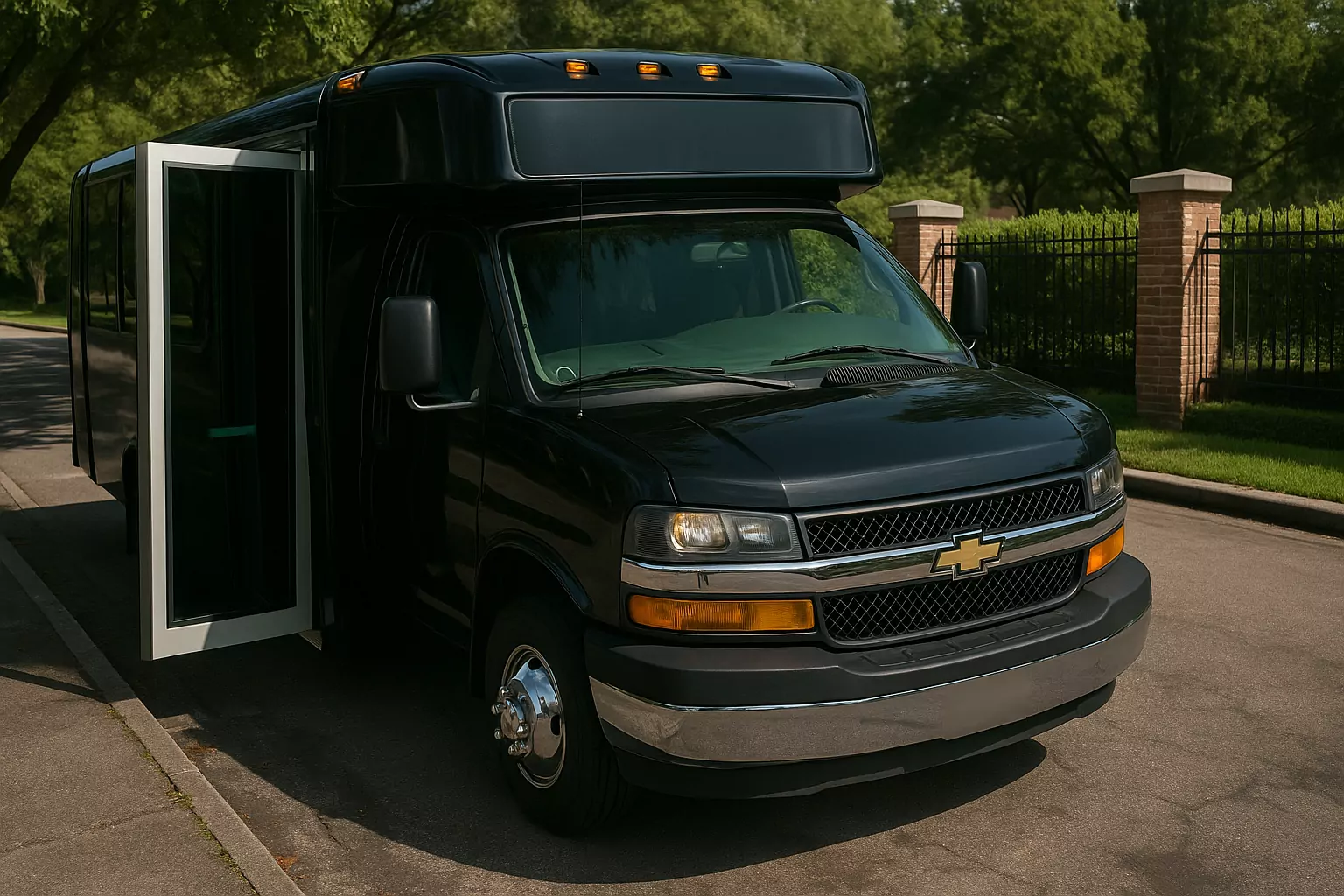
- A department or arrival wave: the 24-passenger shuttle bus, with overhead racks and a rear luggage area. Unused seats are often what makes room for the bags.
- Thirty or more, or heavy luggage: a full-size coach such as the 56-passenger charter coach, whose under-floor bays take a suitcase and a carry-on per seat.
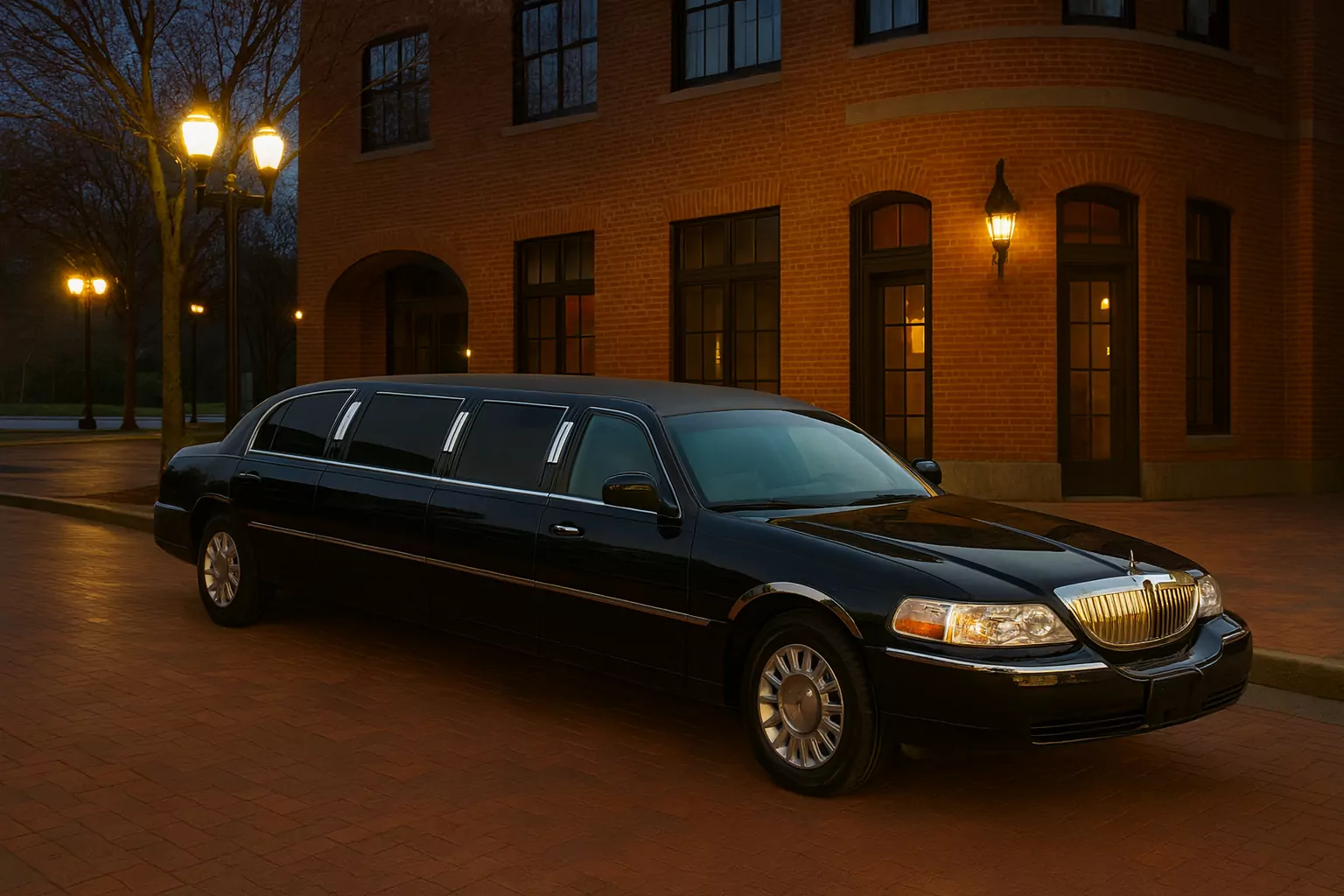
Party buses and stretch limousines are simply the wrong tool. Seating around the walls, barely any floor, nowhere for a suitcase - it doesn't matter how good they look at the curb.
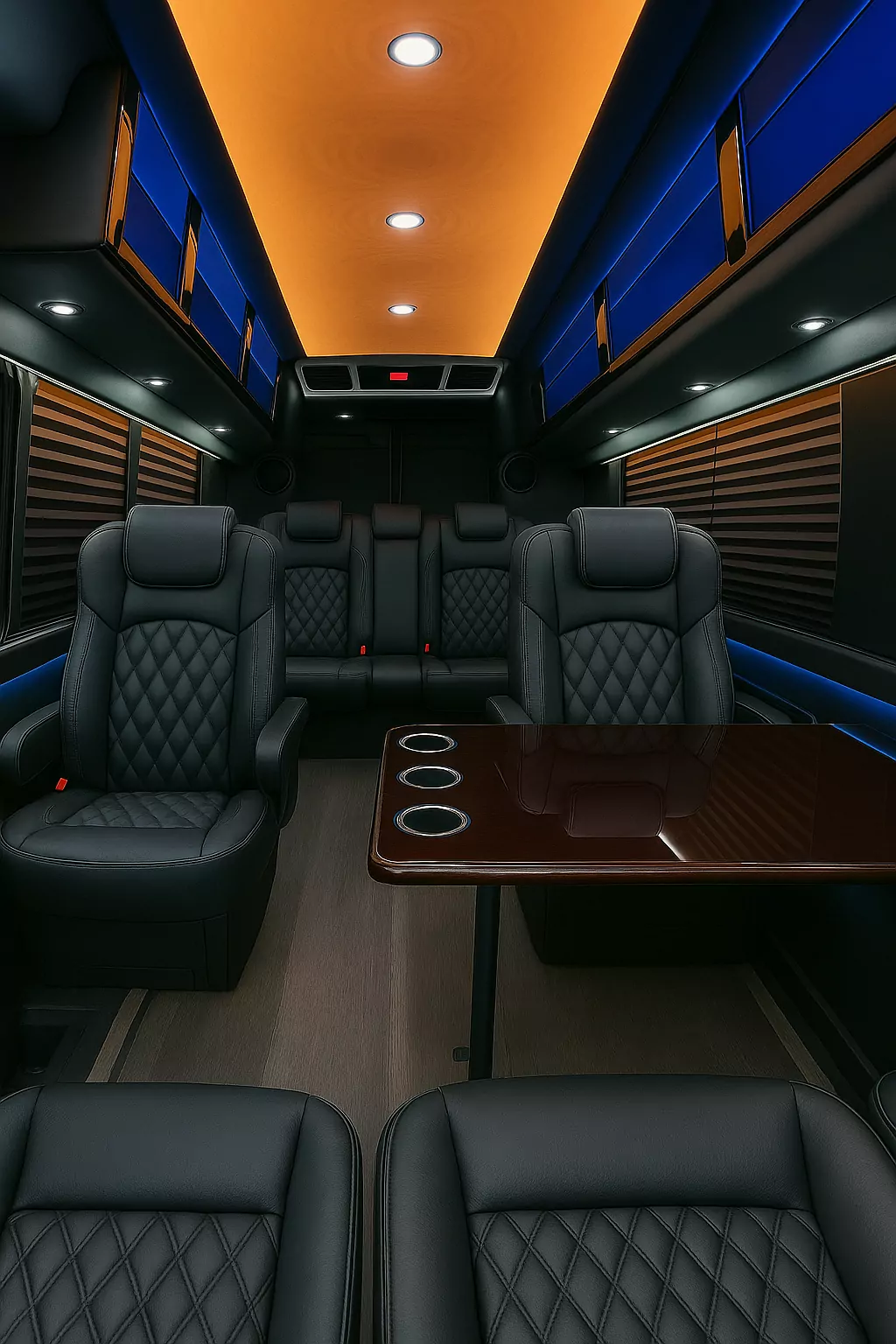 Chairs facing forward and a table, for people who intend to work on the way in.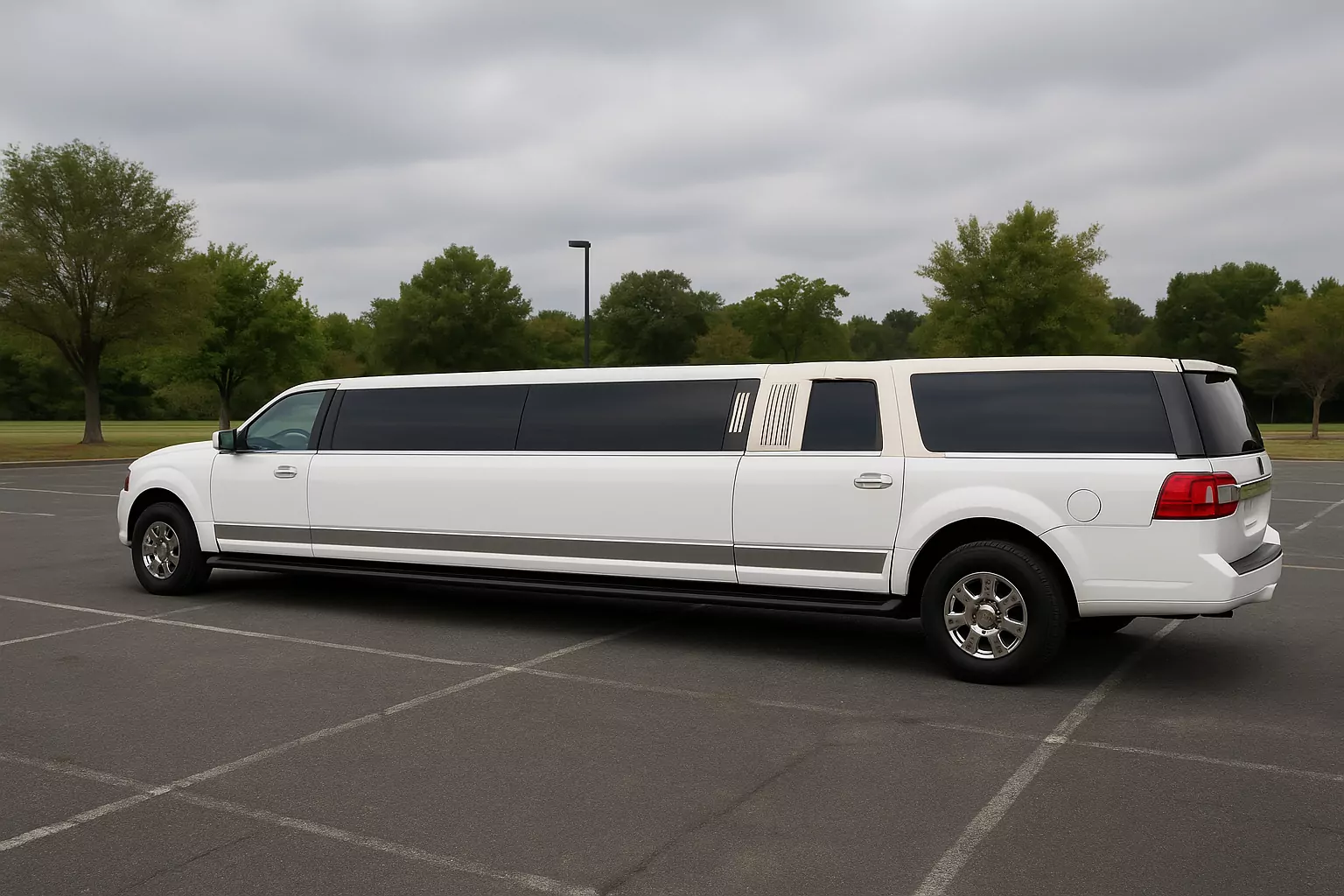
Free planning tool
Vehicle Compare
Party bus, limousine, Sprinter, shuttle, or coach: compare them side by side for your trip.
Compare vehicles →What the numbers say about business-sized groups
We don't have enough airport-only or corporate-only records to publish figures for either, so read these as the overall picture rather than your picture. In our Houston inquiry data, about 31% of inquiries with a group size were for ten passengers or fewer - Sprinter country, and roughly the shape of a leadership team or a visiting client group.
About 53% of inquiries where hours were requested were for three to four hours. That's a useful anchor for a coordinator: a weekday airport run with a hotel stop, or an office-to-site trip and back, tends to sit inside a block that length.
About 13% were for 21 to 30 passengers, which is the point where one shuttle quietly beats two Sprinters. Everyone lands at the hotel together, checks in together, and your lead counts one set of heads rather than reconciling two.
Roadshows and routes that repeat
When the same people move over several days, or the same route runs on a schedule, quote the whole thing at once. What we need:
- The days and the rough daily timetable, including gaps. A morning run and an evening run can be one long block or two shorter ones, and which costs less depends on the gap.
- Passenger counts per leg, since day two is often smaller than day one.
- Whether the vehicle should stay with the group between meetings or drop and return.
- One day-of contact who is actually riding, not the person who booked from another office.
Weekday and daytime work can often book at a three-hour minimum. Friday and Saturday nights carry four, and every Saturday in March, April and May carries six - so if a roadshow brushes against an April Saturday, check it early rather than late.
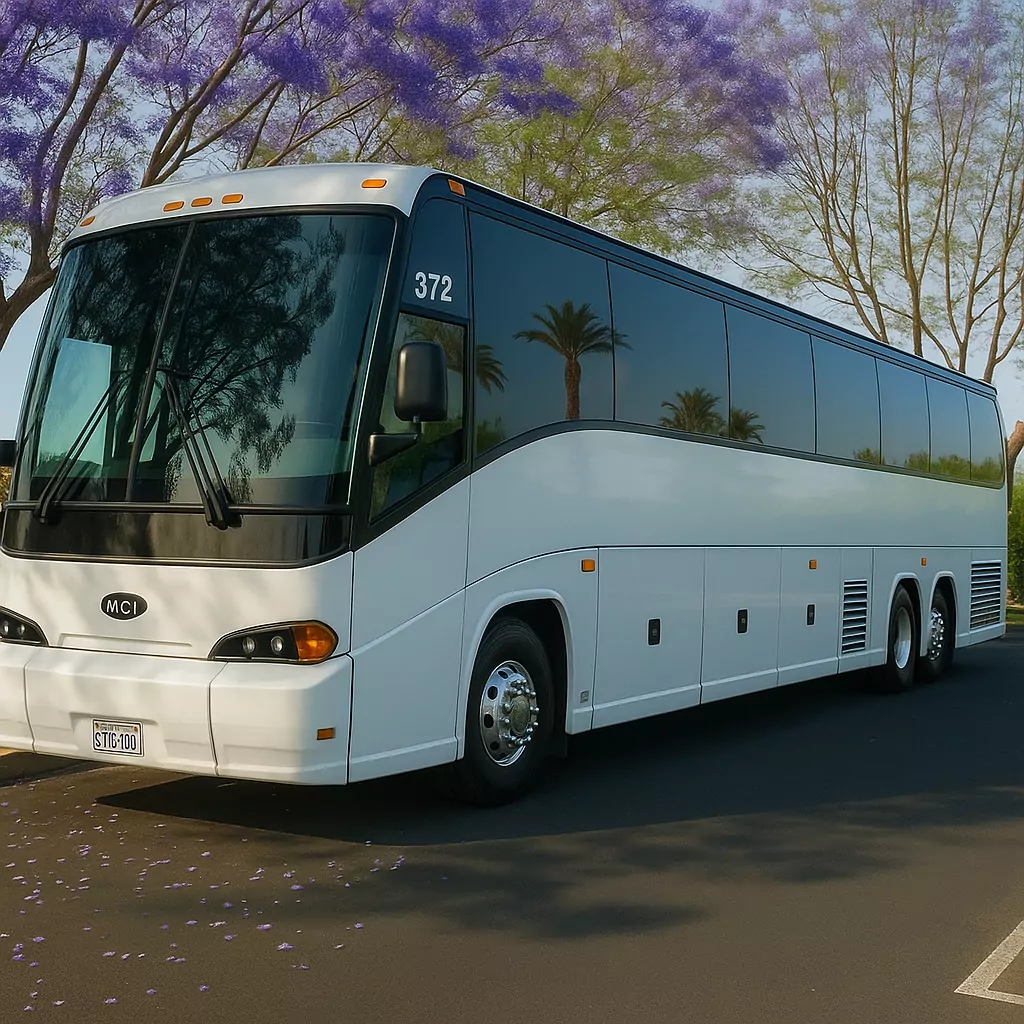 Luggage rides below the floor on a full-size coach, which leaves the cabin for people.
Suburban office parks and hotel clusters are normal starting points for us. The Woodlands out to the Energy Corridor, or Sugar Land into downtown - that's routine Greater Houston work. Mileage inside our standard area is in the quote; anything that takes the vehicle more than about an hour's drive from our base gets priced as long-distance. The fly-in-and-sail day runs on a tighter clock than any of this, and our cruise transfer page covers Galveston port timing.
Want a number for your date?
Send the date, headcount, pickup area, and hours. The quote you get back already includes the driver, fuel, tax, and gratuity.
Approvals and billing, before they bite you
More corporate trips die in an approval queue than for want of a vehicle. Settle these early:
- Who signs. The contract holder must be 21 or older and accepts responsibility for the vehicle. On a company trip that is usually the coordinator or a manager.
- The deposit. A signed contract and a 50% deposit hold the vehicle. A quote alone reserves nothing, so a slow approval chain can lose a date.
- The balance. It falls due 7 to 14 days before the trip. If finance needs particular documents before releasing payment, tell us when you ask for the quote.
- Changes and cancellations. Deposits are non-refundable, and canceling inside 7 days of the trip carries the full amount. Headcount changes are easier to absorb the earlier we hear them. Our rental terms set out the details.
What you're quoted is all of it - vehicle, professional driver, fuel, local mileage, taxes and the driver's gratuity, one line on the expense report. The things that can sit outside it we'll name up front: overtime past your block, long-distance mileage, any extra airport wait you asked for, and a second driver once a day runs past roughly 12 hours. When you're ready, send the manifest with your quote request and we'll come back with a plan rather than a price and a shrug.
Ready to put this on a bus?
Tell us the date, your pickup ZIP, how many people, and how many hours. We will come back with an all-inclusive number — driver, fuel, tax, and gratuity included.